Why I Still Believe in the Muse — Even in the Age of AI
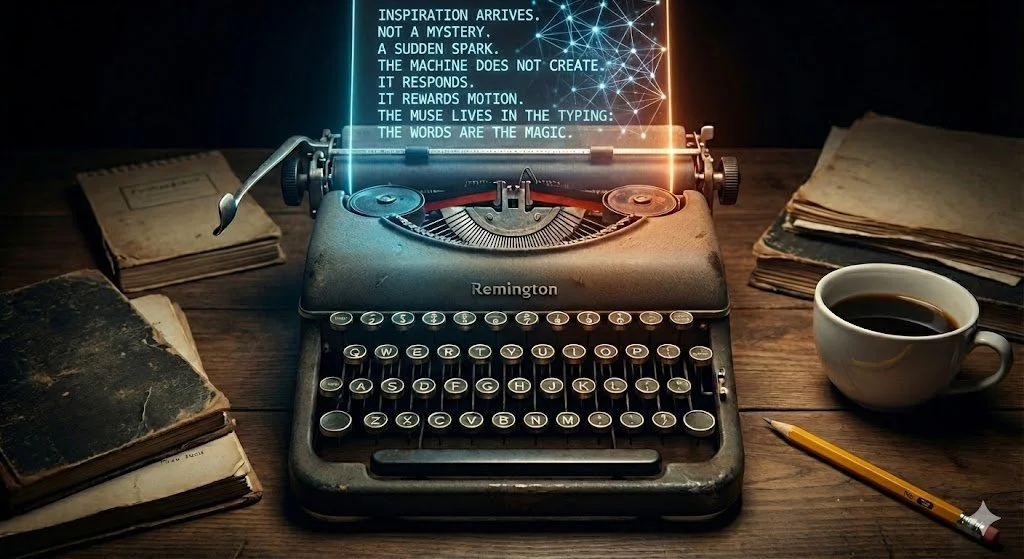
Image created by Gemini, using this post as a prompt.
Years ago, when I was still a reporter, I had the chance to interview author Ray Bradbury.
I went in ready to talk about books. Instead, we talked about his muse.
Bradbury described inspiration the way you might describe weather — something that shows up whether you’re ready or not. He told me it often arrived in the middle of the night. When it did, he didn’t negotiate with it. He got out of bed, walked into the other room, sat down at his manual typewriter, and started pounding keys before whatever had lit up in his brain had time to fade.
He didn’t wait for perfection. He moved.
I’ve thought about that conversation a lot lately, especially as writers argue about AI.I saw a post recently, either on LinkedIn or Facebook, where a writer said he’d rather shrivel up and die than use AI in his writing.
I understand the reaction. Writing is personal. It’s identity. It’s hours alone with sentences that don’t behave and adorable, annoying puppies that demand attention when you are in the middle of an important thought. It’s sending something into the world and hoping it lands the way you meant it to.
But here’s what keeps tugging at me: The magic was never in Bradbury’s typewriter. It was in his willingness to respond when inspiration arrived. I’m sure other writers have similar stories — a whisper, a shout, an idea that refuses to be ignored.
Today, my muse doesn’t wake me up with the sound of metal keys.It shows up as a question, maybe even a snarky response as I poke and prod my various LLMs for ideas and inspiration.
Most of the time, it’s the AI challenging me to take another approach, flip the scenario, reframe the premise.
And here’s where I’m going to be completely transparent. I wrote this post with AI, using ChatGPT and Gemini. I wasn’t looking for speed. Heck, I could have written this final version much quicker than the countless drafts, critiques, and “discussions” I had with the LLMs about the craft of writing.
I did it because I wanted to test the process.
I wanted to see how each system reacted to the same draft. One gave me structural feedback. The other challenged my tone and rhythm. One felt like a copy editor. The other felt like a news editor asking, “Yeah, but what’s the point?”
If you’ve worked in a newsroom, you know that dynamic. You don’t publish straight from your notebook. You run it past people who see what you missed. They push, prod, and sometimes yell at you to not bury the lede.
Because writers have blind spots.
We fall in love with our own metaphors. We skim past weak transitions. We don’t always hear how something sounds outside our own heads.
That’s what these tools are for me. They are not ghostwriters. They are editors, mirrors, and more importantly, muses that have unlocked a long-suppressed desire to write again.
Not writing for work or for my Re-frame blog, but writing short stories and maybe even a book or two.
So, I reject the notion that AI is here to replace creative spirit. I think it helps expose it. It forces us to decide whether we’re using tools to avoid the work or to go deeper into it.
There are days I don’t love how easy it feels. Some days I worry I’m outsourcing my thinking to an AI, then I snap back to reality and skim through the hundreds of interactions I’ve had with AI the last three years.
Instead of a tattered notebook with chicken scratch writing, I have a messy collection of ideas—both good and bad—committed to the digital memory of my AI muse.
Like Bradbury, I’m just grateful for the nudge that gets me moving.
And while I have my digital muse to thank for the spark, it’s still the neurons firing away in this human brain that impart the soul.