Proof Over Persuasion: Reframing the Claims We’re Sold
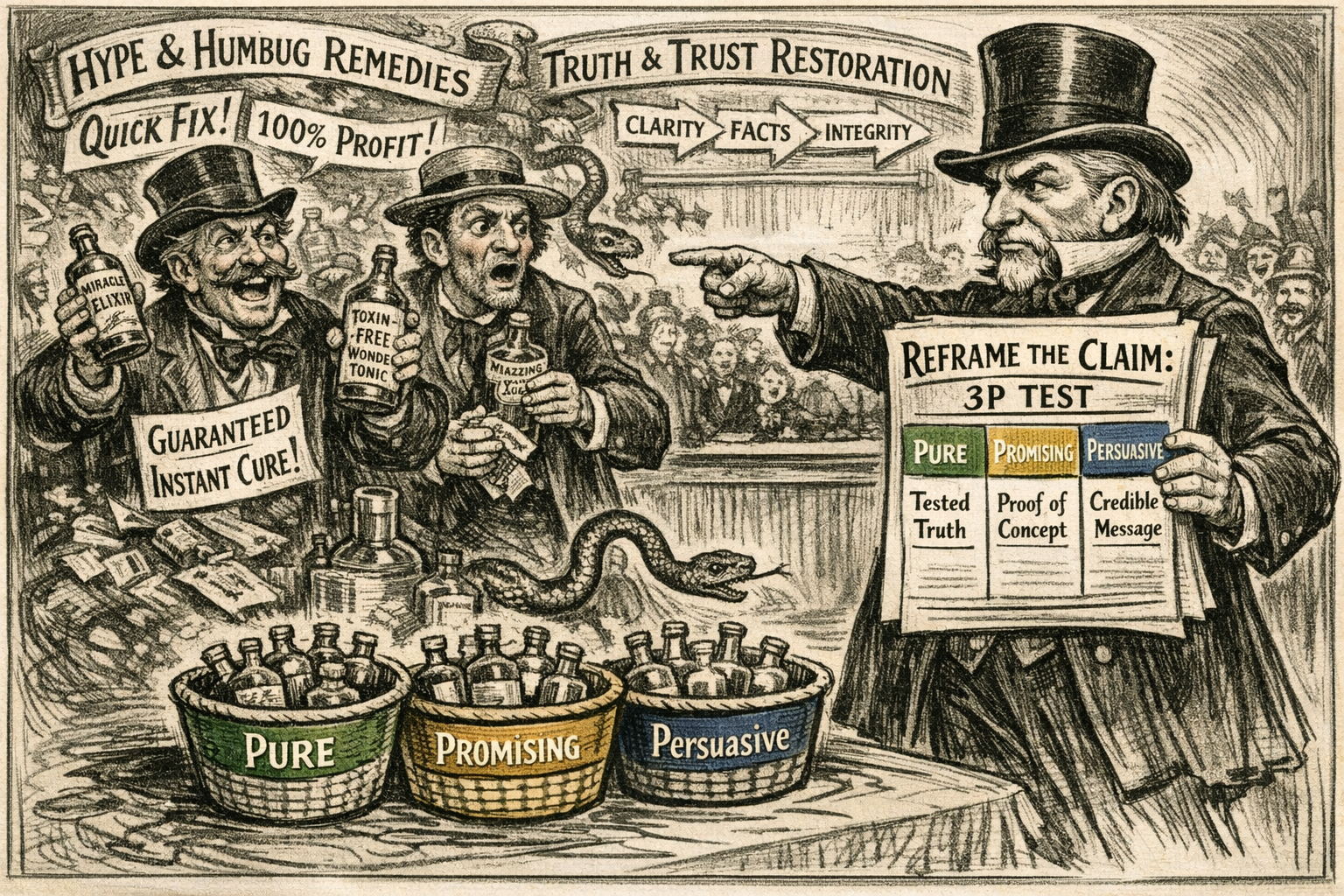
Reframing snake oil pitches (a nod to Thomas Nast) - created using ChatGPT
In communications, you learn quickly that trust isn’t built by sounding certain. It’s built by being specific, evidence‑based, and willing to show your work.
That’s why modern product marketing fascinates and frustrates me. So many claims arrive wrapped in confidence, while the proof underneath is vague, selective, or missing entirely. The bigger the promise —energy, focus, weight loss, “detox,” blood sugar support — the more it becomes a quiet test of discipline:
Can we separate facts from persuasion without becoming cynical?
Why Re-frame the Claim?
Re-frame the Claim wasn’t created because I think everyone is lying. (Full disclosure and a bit of irony: Reframe the Claim was built using ChatGPT, so I am using AI to check the veracity of claims often hyped using AI.)
It was created because I think we’re all trying to be healthier, sharper, more financially stable, more in control. And the modern marketplace is engineered to reward persuasion far more than proof.
“Toxin‑free” coffee.
“A1C hacks.”
“Clinically proven” gummies.
“Doctor‑approved” everything.
The language is confident. The testimonials are endless. The urgency is… suspiciously convenient.
And I’m not immune.
I’ve felt the pull of maybe this is the shortcut I need… to lose a few pounds, lower cholesterol, feel better faster. I’ve clicked. I’ve wondered. I’ve wanted the simple answer, like everyone else.
That’s why I built a tool to slow the moment down.
A nod to Carl Sagan (because he saw this coming)
Re-frame the Claim is a modern companion to Carl Sagan’s idea of a “baloney detector”, not as reflexive disbelief, but as a discipline of thinking.
Sagan wasn’t anti‑science. He was pro‑thinking.
This tool tries to keep that spirit alive in an era where AI can generate persuasive copy in seconds and misinformation can put on a lab coat whenever it wants.
Skepticism with empathy, not cynicism
There’s a difference between cynicism and healthy skepticism:
Cynicism says: “This is probably a scam.”
Healthy skepticism says: “This might be true. Show me what supports it.”
Re-frame the Claim is built for the second mindset.
It’s not a gotcha machine. It’s not about shaming buyers or dunking on brands. It’s about protecting something that’s getting rarer: trust anchored to facts.
What the tool does (in plain English)
Reframe the Claim takes marketing messages and does three things:
Extracts the actual claim (not the vibe)
Turns it into testable statements
Looks for credible receipts: independent sources, not just testimonials and cherry‑picked blurbs
Then it sorts what it finds into a simple framework:
Pure: Verifiable facts (ingredients, certifications, standards, measurable specs)
Promising: Plausible benefits with some support, often limited or context‑specific
Persuasive: Emotional or inflated claims that rely on implication, ambiguity, or unfalsifiable language
This is about separating what’s true, what’s possible, and what’s mostly performance art.
It’s evolving on purpose
Reframe the Claim isn’t a finished doctrine. It’s an evolving tool.
Some claims are straightforward. Others live in the messy middle, where evidence is early, mixed, poorly translated into marketing language, or missing altogether. The goal isn’t to declare final truth. The goal is to apply evidentiary discipline consistently and honestly.
The backbone: PICOT (discipline over vibes)
One of the guardrails built into the tool is PICOT, a framework from evidence‑based practice that forces claims to be answerable:
P – Population: Who is this for?
I – Intervention: What exactly is being done or taken?
C – Comparison: Compared to what: placebo, standard practice, another product?
O – Outcome: What measurable result is promised?
T – Time: Over what timeframe?
Marketing loves to blur these details. PICOT forces clarity.
Instead of:
“Supports healthy blood sugar”
You ask:
In adults with prediabetes (P), does supplement X (I), compared to placebo (C), reduce A1C (O) over X weeks (T)?
That’s not cynicism. That’s precision.
Why this matters now
We’re living in a moment where persuasive content can be produced instantly, “science‑y” language can be generated at scale, and people are expected to do PhD‑level filtering while grocery shopping.
Re-frame the Claim exists to help people build confidence in a product, service, or offering based on facts, not fear.
The takeaway and an invitation
Next time a claim catches your attention, try this:
What’s the claim in one sentence?
What would have to be true for it to be true?
What evidence would prove it false?
Does the pitch invite scrutiny—or rush you past it?
If you want help slowing that moment down, that’s exactly what Re-frame the Claim is for. Drop in a claim, an ad, or a product page and let the tool do what marketing often avoids: define the claim clearly, surface the evidence, and separate signal from persuasion.
The goal isn’t to feel smarter than marketing. It’s to feel grounded in reality before you spend money, change behavior, or hand your trust to someone else’s confidence.