The Syncopated Scroll: Riffing with the Machine
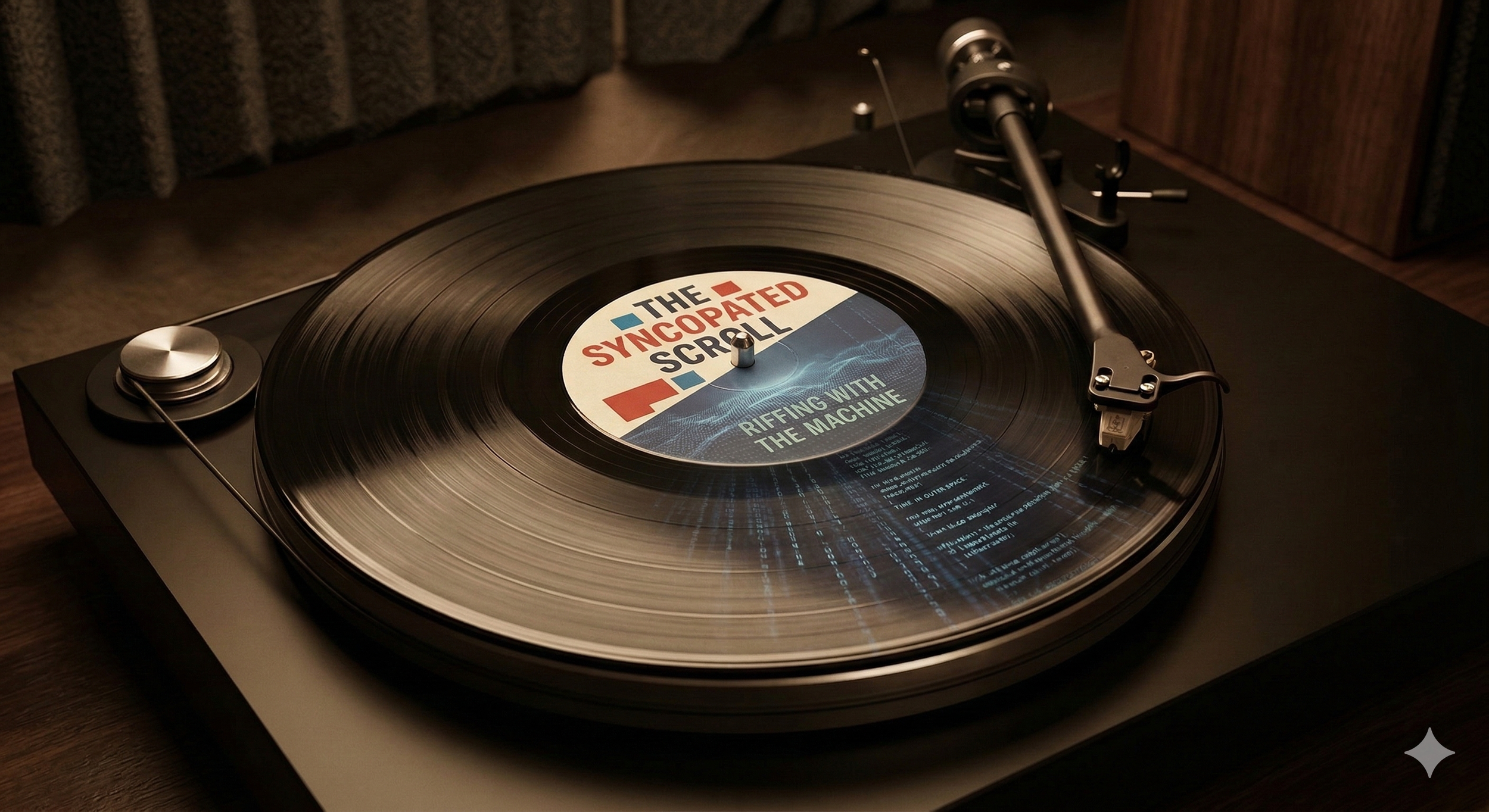
A Nano Banana riff on the concept of syncopation in jazz and writing
I recently picked up a copy of jazz great Dave Brubeck’s Countdown: Time in Outer Space. Dropping the needle on that record feels like a lesson in controlled volatility. Brubeck was playing with time in ways that should have sounded awkward, even unstable, yet somehow it all held together. The music felt restless, searching, alive.
It took me back to a smoky jazz club in Chicago years ago, where the music did more than fill the room. It shaped the environment. You could see it in the way people moved, leaned in, and gave themselves over to something they could not quite predict.
That is what great experimentation does. At first it feels unfamiliar, maybe even a little uncomfortable. Then, if the artist knows what they are doing, the unfamiliar becomes its own kind of fluency.
Listening to Brubeck on vinyl, I kept coming back to that idea. Brubeck bent time signatures in ways that pushed listeners just far enough off balance to make them listen differently. Jack Kerouac did something similar with prose. His spontaneous style pushed against tidy, conventional structure and chased momentum, voice, and motion instead. Different forms. Same instinct. Stop fighting the form. Push it. See what it can do.
That is part of what makes today’s conversation about AI so interesting to me.
AI is not the soloist. It is not the author of meaning. It is the responsive instrument beside you, ready to offer variation, contrast, tension, and surprise. Used poorly, it can flatten thinking into mush. Used well, it can help you hear possibilities you would not have reached as quickly on your own.
And that is where many people get stuck. They approach AI like a vending machine for finished answers. They would get more from it if they approached it more like a creative exchange.
In fact, this piece began the same way: not as a solitary draft, but as a back-and-forth with two AI session mates, trading short bursts of thought, challenge, and variation until the shape of the idea emerged.
The Liner Notes: Working with the Algorithm
To work that way, you have to stop treating the interface like a search box and start treating it like a practice room.
Track 1: Trading Eights.
In jazz, “trading eights” is when musicians take turns responding to each other in short bursts, building on what came just before. That is a useful way to work with AI. Do not ask it to write the whole piece. Give it a paragraph. Ask for a counterpoint. Push back. Revise. The value is not in surrendering the work. It is in the exchange.
Track 2: The Transposition.
To transpose a piece of music is to move it into another key so you can hear the same idea differently. The writing version is just as useful. If an argument feels stale, change the frame. Ask AI to reframe it through a different voice, discipline, or perspective: a noir detective, a mid-century architect, a skeptical editor, a plant-floor supervisor. Sometimes the shift is enough to help you hear your own thinking more clearly.
Track 3: The Woodshed.
Musicians “woodshed” when they retreat into private practice, working through rough spots without an audience. AI can serve the same purpose. Use it as a place to experiment without consequence. Throw out half-formed thoughts. Test bad ideas. Chase strange associations. Most of it will not be worth keeping. That is fine. Discovery has always involved a little mess.
Track 4: The Master Take.
Every recording session produces multiple takes, but only one makes the album. This is the part people cannot outsource. Brubeck chose what made the record. Kerouac, despite the mythology, still shaped the work. The human being decides what stays, what goes, and what is true. AI can generate options. It cannot replace judgment.
The Final Outro
That, to me, is the opportunity. Not reckless creativity. Not blind trust. Not machine-made originality. Something more disciplined than that, and more interesting.
A willingness to explore without giving up authorship. A willingness to test a thought, stretch a sentence, shift perspective, and see whether something unexpected appears. Sometimes it will not. Sometimes it will. But every now and then you hit a note you did not know you were reaching for until you hear it ring back at you.
That is not the machine replacing the artist.
That is the artist learning how to play a new instrument.