The Look Is the Plot: What Andor and Palm Royale Reveal About Organizational Truth
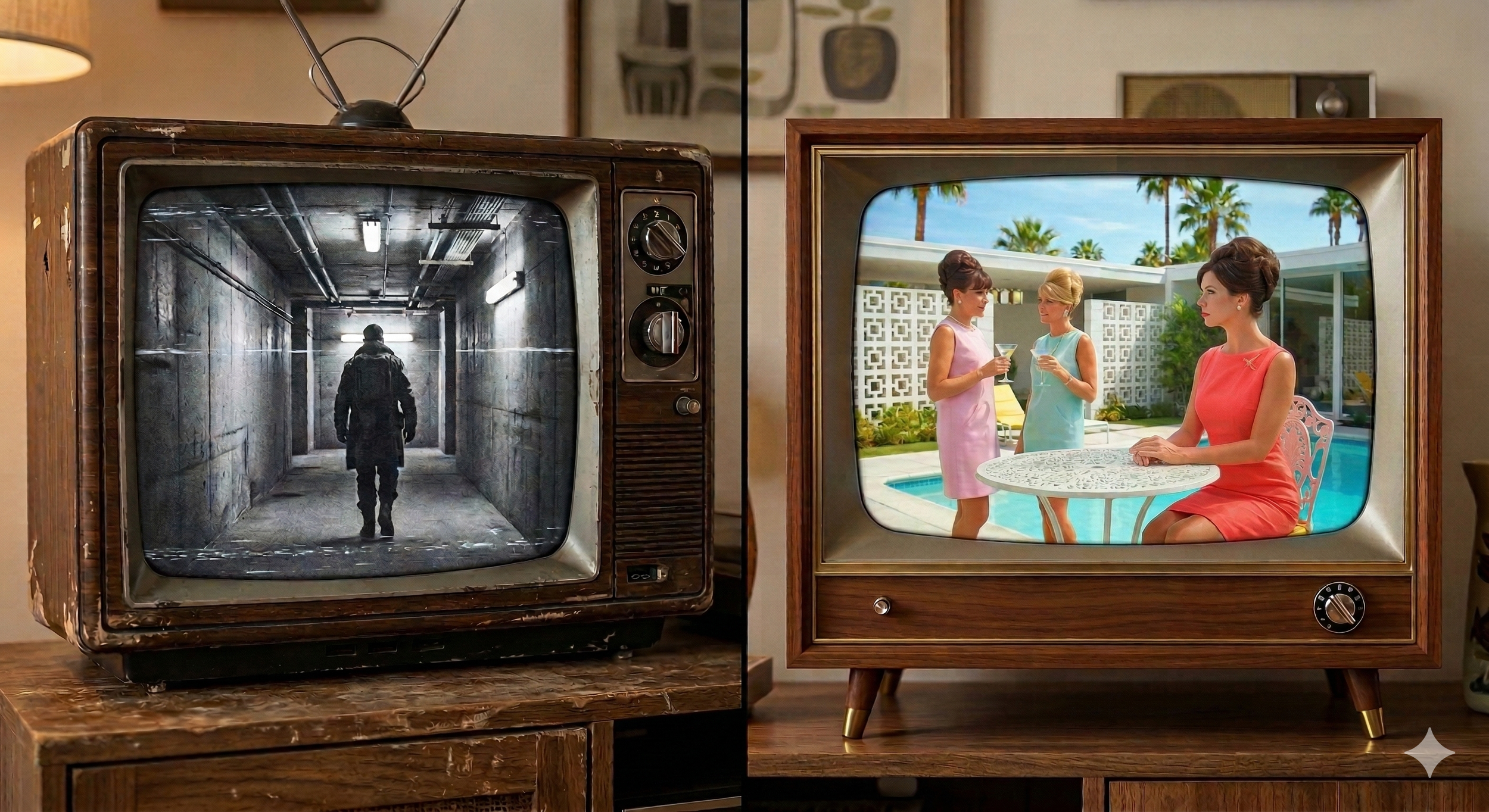
Two worlds. Two aesthetics. Two similar effects. Imagined by Nano Banana 2
My wife and I do not just watch a show. We settle into it. We pay attention to its temperature, its pressure, the way a room is lit, the way people move through space, the way a setting quietly tells you what kind of truth can survive there.
That is why the best stories do not use aesthetics as decoration.
They use them as narrative force.
Two very different shows brought that back to me recently: Andor and Palm Royale. On the surface, they have almost nothing in common. One is built around surveillance, control, and resistance. The other arrives wrapped in color, status, beauty, and performance.
Yet both understand the same thing: The look of a story is not ornamental. It is structural.
The Exhaustion of the Industrial
In Andor, the world is stripped down and merciless. The Empire is not a melodramatic villain. It is a procedural one. Corridors, walls, and institutions are engineered to reduce people into functions. Before a single line of dialogue explains the system, you can feel what it does: It shrinks the human being.
That tension sharpens in the contrast between Cassian and Dedra.
Cassian moves through this world as someone pressed on by it, shaped by it, punished by it, and finally pushed toward resistance.
Dedra moves through that same hard geometry in a similar fashion, but instead of resisting, she gives in and learns how to wield it.
The aesthetic is the same, but it reveals two different truths: what it means to be processed by power, and what it means to internalize its logic so completely that control begins to look like order. Rebellion here is not romantic. It is the desperate recovery of humanity inside a machine built to erase it.
The Terror of the Saturated
Palm Royale gets to a similar truth from the opposite direction. The brightness is not just pretty. It is demanding. The symmetry and polish do not simply create style; they create discipline. The surface tells you who belongs and how much performance is required to stay inside the lines.
Look at Maxine and Norma.
Maxine is straining, always trying to prove she can wear the world convincingly.
Norma does not need to prove anything. She embodies the authority of a world that already recognizes itself in her.
That is what makes the beauty feel tense instead of comforting. The visual pleasure is real, but so is the pressure beneath it. The show is not just about glamour. It is about admission, status, and who gets to set the terms of reality.
The Organizational Aesthetic
This matters beyond the screen. It matters in our organizations.
Most communicators are doing more aesthetic work than they realize. We choose the tone, the pacing, the gloss of a slide deck, and what we leave in the shadows. All of it signals.
When the aesthetic of a message says optimism and polish while the lived experience of the audience says uncertainty and pressure, the result is not just misalignment. It is distrust.
People push back when they are told to accept a mood that the facts do not support.
Four ways to make communication feel honest
To communicate without the hollow ring of propaganda, we have to stop trying to make the message prettier and start making it more truthful.
Use specifics instead of slogans.
Slogans are wallpaper. Specifics are anchors. People can rally around a call to action when they understand the issue, the stakes, and the consequences.
Make proof visible.
Don’t hide the facts. Provide details that show why the message matters and what is being asked of people.
Acknowledge the unknown.
Don’t be afraid to say the future is uncertain. Honest communication names what is known, what is not yet known, and how you intend to keep people informed as things evolve.
Match the tone to the stakes.
If people are carrying real concern, do not wrap it in cheerfulness that has not been earned.
Aesthetics are never neutral. They tell people what is real, what is safe, and who belongs, often before the first word is even spoken.