Part 1: How I reinvented myself 5 times in 25 years
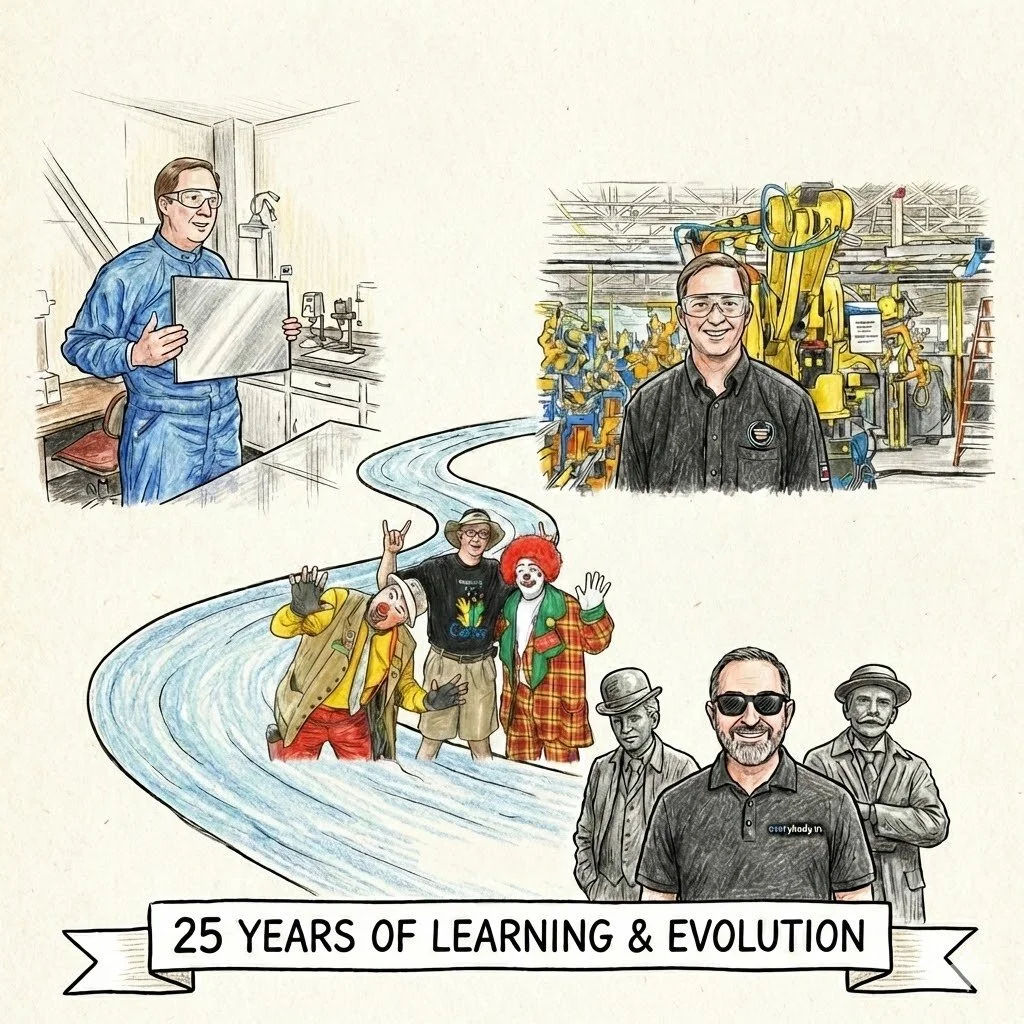
Images from throughout my GM career, compiled by Nano Banana
When I look back at 25 years at General Motors, I do not see one long career. I see reinvention. Same company, same badge, but five different versions of me. Each one shaped by different leaders, different moments, different stakes, and a steady dose of humility.
This is not a victory lap. It’s a reflection on what time actually does to you when the work keeps evolving, and you choose to evolve with it. And if you are looking for any titillating insider stories, sorry, I’m not that kind of person. This is about what I learned in 25 years, and what I hope will help people who are early in their career or seasoned leaders.
1) The Observer
My first career was built on a simple instinct: notice what others miss.
That observer mindset came from my journalism roots. I spent 13 years as a reporter and editor, trained to look deeper, ask probing questions. L Do not accept the first explanation if it feels too neat. Pay attention to what people do, not just what they say. Learn the difference between noise and signal.
GM taught me something important early. Big organizations do not lack stories. They lack clarity about which stories matter, and the courage to sit with complexity long enough to understand it.
The observer phase gave me a foundation I still use today. Curiosity is not a personality trait. It is a professional discipline.
2) The Translator
Then I became a translator.
Not between languages, but between worlds.
Engineers, designers, manufacturing teams, leaders, employees, customers. Each group speaks with its own shorthand. Each group assumes the other groups see the world the same way. They do not.
This stage taught me that communication is not about sounding polished. It is about being accurate, human, and clear at the same time. That is harder than it looks.
Translation is also where I learned a painful lesson. If you oversimplify, you insult people’s intelligence. If you overcomplicate, you lose them. The job is not choosing one or the other. The job is doing the hard work so others do not have to.
3) The Bridge-Builder
At some point, I realized the real challenge was not writing. It was trust.
So the third career became bridge-building.
Bridges are not built with slogans. They are built with credibility, consistency, and the kind of listening that makes people feel seen instead of managed.
When people say “alignment,” it can sound like corporate theater. What I learned at GM is that alignment is actually a fragile human achievement. It requires context. It requires a shared understanding of what is changing and why. It requires leaders who can explain decisions without hiding behind buzzwords.
Bridge-building also means getting comfortable with tension. There are moments when two sides both have valid concerns, and your job is not to pick a winner. Your job is to help everyone see the same reality and then move forward anyway.
4) The Storyteller With Stakes
The fourth career was storytelling with stakes.
Every communicator likes a good narrative. Not every communicator spends time close to stories where trust is the product, credibility is the currency, and consequences are real.
In this phase, I learned that “clarity” is not a nice-to-have. It is a form of respect. Truth is not a brand value. It is a choice you make when it would be easier to soften the edges. Alignment is not a PowerPoint outcome. It is what happens when people believe they are being told the whole story.
This is where my definition of “good communication” sharpened.
Good communication does not simply inform. It protects understanding. It keeps people from filling in gaps with assumptions. It reduces fear, speculation, and cynicism by putting real context in the open.
And it reminded me that the best stories are not the flashy ones. They are the honest ones.
5) The Future-Builder
Now I’m in the fifth career: future-building.
That does not mean chasing shiny tools. It means helping people adapt to change that is already here.
AI is the obvious example right now. The conversation is full of hype: agents, autonomy, orchestration, prompts, copilots for everything. Useful, sure.
But I keep coming back to a quieter truth. The differentiator is not the tool. It is engagement.
Adoption is not an IT rollout problem. It is a human confidence problem. People do not resist change because they are stubborn. They resist because they do not feel safe looking inexperienced in a world that expects competence.
The future-builder role is about creating the conditions where people can learn without feeling exposed. Where leaders model curiosity instead of pretending they have it all figured out. Where communication is not a broadcast, but a system that helps employees navigate uncertainty with clarity and momentum.
The Thread Through All Five Careers
Looking across these five reinventions, one thread holds.
Clarity. Truth. Alignment.
Clarity without truth becomes spin. Truth without clarity becomes noise. Alignment without either becomes compliance, not commitment.
The other thread is perspective. Each reinvention started when I stopped looking straight at the work and started looking at it from a new angle. I changed what I paid attention to, what I valued, and what I thought my job actually was.
That is the part I wish more people understood about careers, especially inside large organizations.
You do not always need to leave to grow. Sometimes you need to reframe the work you are already doing, and become a different version of yourself inside it.
A Question Worth Asking
If you are early in your career, here is my honest advice.
Do not chase the perfect title. Chase the next reinvention.
Ask yourself:
What am I learning that is changing me?
What do I believe now that I did not believe two years ago?
Where am I still acting like the observer when it is time to become the translator?
Where am I translating when it is time to build bridges?
Where am I building bridges when it is time to help others face the future?
Twenty-five years at one company sounds like a number.
To me, it looks like five careers. And the most important part is not the time.
It’s the change.