Still There
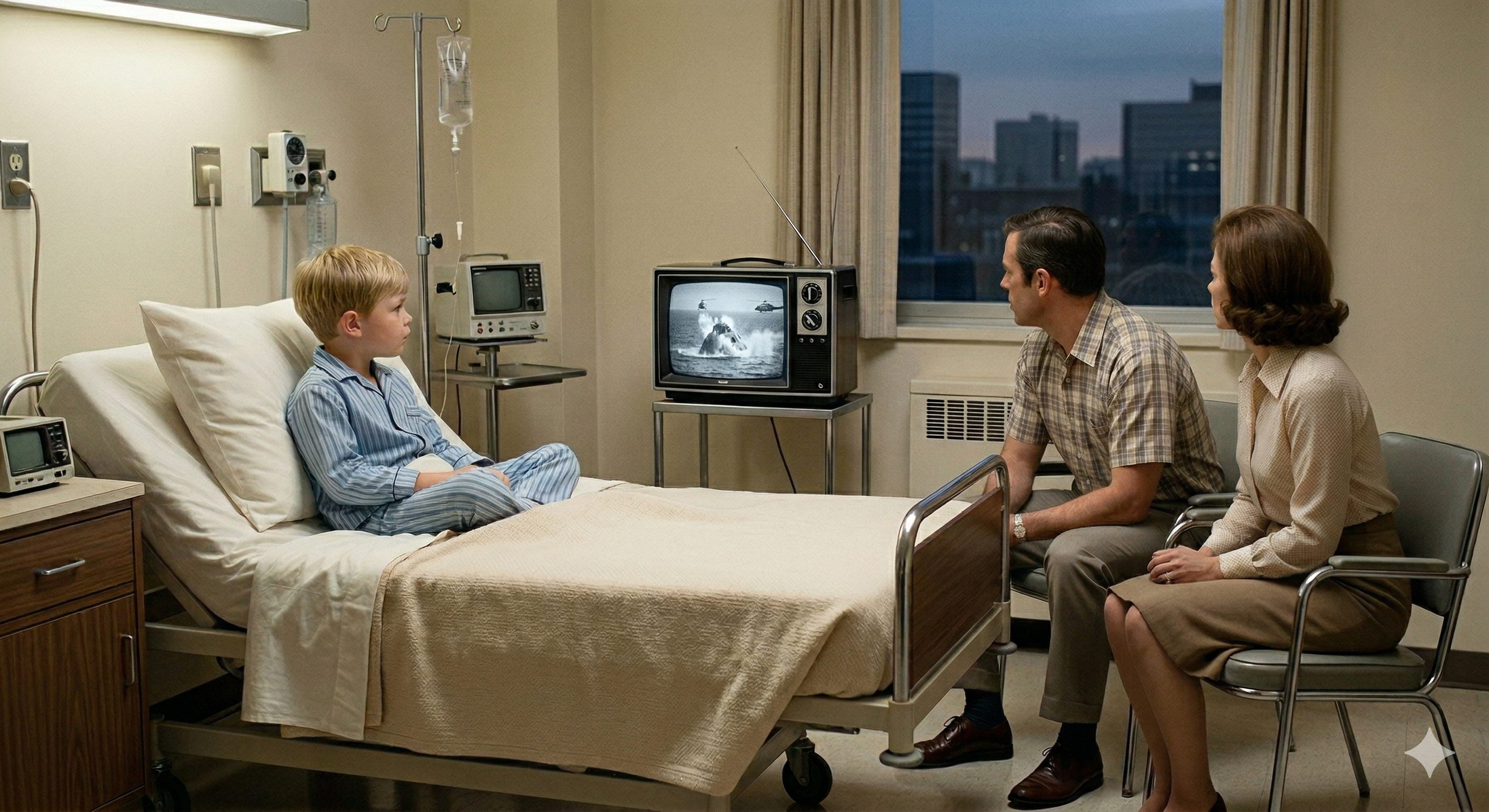
Memory re-imagined by Nano Banana Pro
It’s the late 1960s. I’m four or five years old, propped up in a Chicago hospital bed after a tonsillectomy. My throat feels like I’ve swallowed a box of broken glass. My parents are in the room, but they aren’t looking at me. Their eyes are fixed on a grainy, flickering television.
I don’t remember the specific Apollo mission number. I just remember the image. A capsule bobbing in the ocean after the splashdown of the latest Apollo moon mission.
But more than the screen, I remember watching my parents.
There was a quiet confidence in the room. Not the loud, frantic excitement we often see today. It was something steadier than that. Even at four or five, I could feel it. This wasn’t just a report about someone else’s achievement. It felt like something happening to all of us. Like we were part of it.
That feeling wasn’t an accident. It was everywhere, in the future-looking stories of Isaac Asimov and Arthur C. Clarke, in the warnings of Ray Bradbury, and in the unsettling beauty of 2001: A Space Odyssey. Some of it was brilliant, some uneven, but it all pointed in one direction: the future wasn’t something being delivered to us. It was a destination we were moving toward together.
The Noise and the Signal
Fast forward. I’m watching Artemis II make its journey around the moon, beginning the long arc home.
The technology is breathtaking. The images are stunning. The precision is undeniable. By every objective measure, this moment is more extraordinary than the one I saw from that hospital bed.
And for a moment, that same quiet pull returns—the sense that something larger than the daily grind has our collective attention.
But the world around it isn’t quiet.
It wasn’t quiet in the late ’60s, either. Apollo unfolded against the backdrop of Vietnam, a time of division and uncertainty. Today, we watch Artemis II while headlines tell a different story here on Earth, unsettled by conflict, division and tension.
The world didn’t pause then. It doesn’t pause now.
And maybe that’s the most human part of the story.
The Choice to Look Up
For all our technological advances and all the complexity we’ve layered into our lives, one thing remains unchanged. We still look up.
We still send people into the unknown. We still gather, in our own scattered ways, to watch. Not because the world is perfect or our problems are solved, but because something in us still responds to the possibility of more.
I keep coming back to my parents in that hospital room. What I saw wasn’t just a triumph of engineering; it was a moment of shared attention, a quiet acknowledgement that, despite everything happening outside those walls, this mattered, too.
Watching Artemis II now, that feeling is still there.
Not louder than everything else. Not stronger than the conflict or the noise. But present.
It’s easy to miss if you’re not looking for it, and easy to overlook if you’re moving too fast.
And maybe that’s what’s changed. Not our capacity for wonder. Not our ability to build something extraordinary. Just how often we choose to notice it.
Because even now, as our world feels unsettled, there are still moments that remind us what we’re capable of.
You just have to look up long enough to see them.